NOCO Boost Plus GB40 Review: Jump-Start Your Car Without Another Vehicle
This guide is based on the maker’s published information and common owner feedback, not on lab testing. We may earn a commission if you buy through our links. How this works.
You turn the key and hear a click. Nothing else. It is early, it is cold, and you are already late. Now you need to find someone with jumper cables, park their car nose to nose with yours, and hope you both remember which clamp goes where. Or wait an hour for roadside assistance.
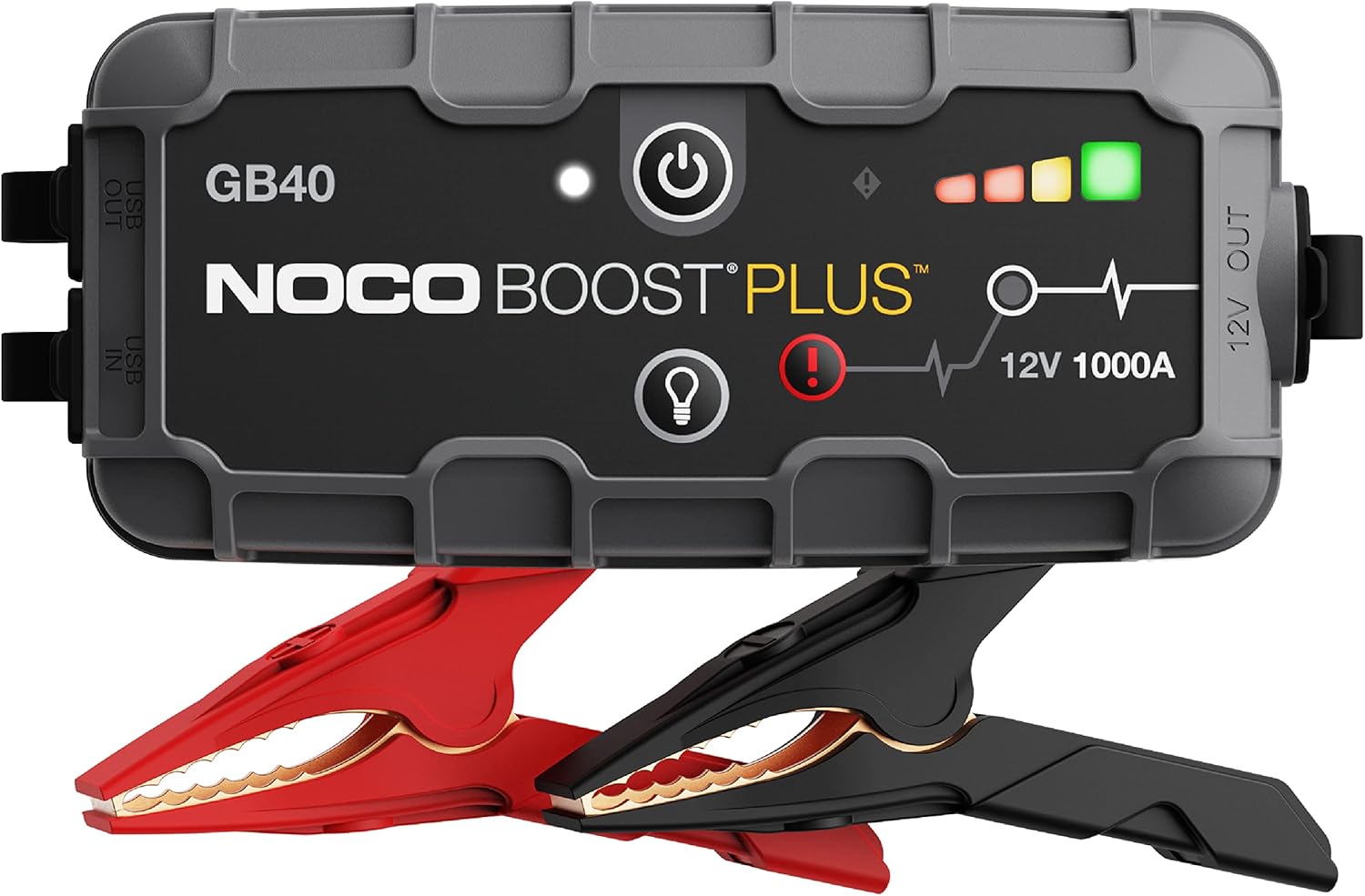
The NOCO Boost Plus GB40 removes other people from that equation. It is a compact lithium jump starter that can start a dead battery by itself in a couple of minutes. It is one of the best-selling car accessories of any kind, and it is the sort of thing you are very glad to own exactly once or twice a year.
This guide explains what it can start, how safe it is, and how to make sure it works when you need it.
What Is the NOCO Boost Plus GB40?
The GB40 is a portable 12-volt lithium-ion jump starter rated at 1000 amps of peak current. NOCO rates it for:
- Gasoline engines up to 6.0 liters
- Diesel engines up to 3.0 liters
That covers most cars, crossovers, SUVs, minivans and many light trucks, along with motorcycles, lawn tractors, boats and ATVs with 12-volt batteries.
It comes with heavy-duty clamps on short cables, and NOCO says a full charge provides up to 20 jump starts.
The key feature for nervous users is the safety system. NOCO calls it UltraSafe: the clamps are spark-proof, and the unit has reverse polarity protection, so it will not send power if the clamps are on the wrong terminals.
It also includes a 100-lumen LED flashlight with several modes including SOS and strobe, and a USB port that can charge a phone.
Key Benefits
No second car needed
You can start your own car in an empty parking lot, a garage or your driveway, with nobody else around.
Hard to get wrong
Connect the clamps the wrong way and it warns you instead of sparking. For anyone who has worried about damaging a car or hurting themselves with jumper cables, this is the main selling point.
Small enough to keep in the car
At about 2.4 pounds and roughly the size of a thick paperback, it fits in a glove box, door pocket or under a seat.
Many starts per charge
Up to 20 starts on one charge means it can rescue you, and then your neighbor, without a top-up.
A flashlight and power bank in the same unit
Dead batteries love to happen in the dark. The built-in light helps you find the terminals, and the USB output keeps your phone alive while you sort things out.
Built for rough conditions
The rubberized casing is rated IP65, meaning it is protected against dust and water spray.
Why Users Love It
Recurring themes in owner feedback:
- "It started first time." The most common comment, often about a completely unresponsive car.
- Confidence. People who had never jump-started a car say they managed it alone in minutes.
- Peace of mind. Owners describe keeping one in each family car, especially for teenage drivers and older relatives.
- Compact size. Easy to store and forget until it is needed.
The complaints are worth understanding:
- It must be kept charged. Owners who left it for a year or more sometimes found it flat when they needed it.
- Slow USB recharge. A full recharge takes around three hours with a 2.1-amp USB charger, and far longer on a weak one. A wall adapter is not included.
- Short cables. The unit has to sit close to the battery.
- Deeply dead batteries. If a battery is so flat that the unit cannot detect it, you need to use the manual override mode, which disables the safety protections and must be used carefully.
- Limits with big engines in deep cold. Large engines at the top of its rating are harder to start in freezing weather.
Our Analysis
This analysis is based on NOCO's published specifications and common owner feedback. We have not run our own starting tests.
What it gets right
- The safety features make jump-starting accessible to people who would otherwise avoid it.
- It is properly sized for the majority of passenger vehicles.
- Build quality and brand reputation are strong in a category full of unknown names with exaggerated ratings.
- The flashlight and USB port are useful extras in an emergency.
Where it falls short
- It is a jump starter, not a charger. It gets the engine running. It does not repair or recharge a failing battery. If your battery keeps dying, have it tested.
- Lithium batteries dislike extreme heat. Do not leave it on a dashboard in direct summer sun. Store it out of the sun, and follow the temperature limits in the manual.
- Bigger engines need a bigger model. Owners of large V8 trucks and diesels above 3.0 liters should step up to a higher-rated unit in the range.
Who should buy it
Almost every driver, and especially commuters, parents of new drivers, people who park on the street, owners of older cars and anyone who drives in cold climates.
Who should buy a larger model
Owners of heavy-duty trucks, large diesels and big-displacement engines.
How to use it
- Switch off the car and all accessories.
- Connect the red clamp to the positive (+) terminal.
- Connect the black clamp to the negative (-) terminal or a bare metal ground point, as your vehicle manual directs.
- Turn the jump starter on and check for the ready light.
- Start the car. If it does not start, wait 20 to 30 seconds and try again.
- Once the engine runs, switch off the unit and remove the black clamp, then the red.
Always read the manual for your vehicle and for the jump starter first.
Keeping it ready
- Recharge it after every use.
- Top it up every three to six months even if unused. Set a phone reminder.
- Keep it out of direct sun and extreme heat.
Specifications
| Spec | Detail |
|---|---|
| Type | Portable lithium-ion jump starter |
| Peak current | 1000 A |
| Voltage | 12 V |
| Gasoline engines | Up to 6.0 L |
| Diesel engines | Up to 3.0 L |
| Jump starts per charge | Up to 20 |
| Safety | Spark-proof, reverse polarity protection |
| Flashlight | 100 lumens, 7 modes including SOS and strobe |
| USB output | Yes, for charging phones and small devices |
| Recharge | By USB, about 3 hours at 2.1 A |
| Protection rating | IP65 |
| Weight | About 2.4 lb |
| In the box | Jump starter, clamps, USB charging cable, storage bag |
Where It Excels
- Cold winter mornings. When weak batteries finally give up.
- Airport parking. After two weeks away with a light left on.
- Rarely driven cars. Second cars, classics and motorcycles.
- Road trips and camping. Far from help.
- New drivers. A safe, simple tool to keep in their car.
The typical owner story is short: it sat in the trunk for months, then saved a morning.
Frequently Asked Questions
How long does it hold a charge?
It can hold charge for many months, and NOCO still recommends topping it up regularly. Every three to six months is a good habit.
Can I leave it in the car?
Yes, in moderate temperatures. Avoid leaving it in direct sun or a very hot cabin in summer, and check the temperature limits in the manual.
Will it start a completely dead battery?
Usually. If the battery is too flat for the unit to detect, the manual override mode can be used with care, following the instructions exactly.
Can it charge my phone?
Yes, through the USB output.
Is it safe for cars with a lot of electronics?
It is designed for modern 12-volt vehicles and has spark-proof and reverse polarity protection. Follow your vehicle manual's jump-starting instructions.
Conclusion: Is the NOCO GB40 Worth Buying?
The NOCO Boost Plus GB40 is one of those purchases that pays for itself the first time you need it. It starts most passenger vehicles, protects you from wiring mistakes, fits in a glove box and doubles as a flashlight and phone charger. It asks only that you keep it charged and out of extreme heat.
For the engine sizes it is rated for, it is the easiest way to make sure a dead battery is a five-minute problem.
Check the current price below.


